
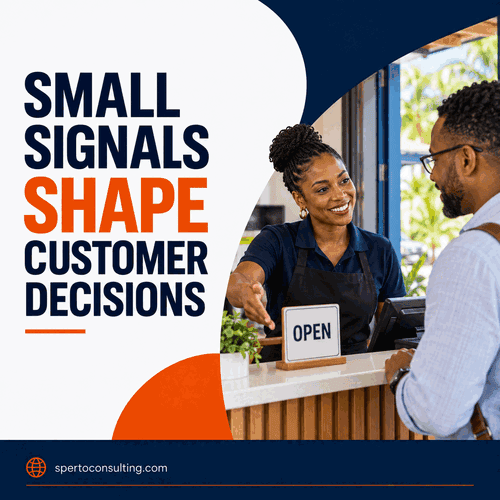
In a recorded conversation, advertising executive Rory Sutherland shared a revealing coffee-shop anecdote. Staff who wanted to leave promptly discovered that turning just one or two chairs upside down before closing was enough to discourage late customers. The business could still be officially open, but the environment communicated something else: you are too late.
The story is anecdotal, not a controlled study. Its lesson is still valuable because it exposes a common management error. A fall in sales near closing time might look like weak demand. In reality, employee behaviour may be suppressing demand before it can become a transaction. As Sutherland's account shows, the numbers record the outcome, while the cause remains hidden unless someone examines the customer experience around it. The published conversation transcript documents the example.
For Caribbean businesses, this is more than a retail observation. Customers may move between a branch, telephone call, WhatsApp message, email, website, social channel, and sales representative before making a decision. Each interaction can signal that the business is responsive and easy to work with, or that the customer should look elsewhere. When teams measure only the final sale, abandonment, or complaint, they risk confusing a process problem with a market problem.
How do simple business behaviours influence customer decisions?
Simple business behaviours influence customer decisions by changing the effort, clarity, confidence, and sense of welcome surrounding a choice. A slow reply, unclear sign, inconsistent price, missing handoff, or premature closing routine can create friction. Clear information, visible availability, reliable follow-up, and an easy next step can reduce it. These details matter because customers respond not only to the product or service, but also to the conditions in which the decision is made.
This is the article's central argument: customer behaviour data becomes more useful when leaders interpret it alongside the operational behaviour that helped produce it.
Customer data shows what happened, not always why
Dashboards are good at revealing patterns. They can show that enquiries fell after 4 p.m., online applications were abandoned at a particular stage, repeat purchases declined, or one location converted fewer prospects than another. The problem begins when a pattern is treated as an explanation.
Historical data cannot, by itself, tell a leader whether customers lost interest, encountered friction, received inconsistent information, or were quietly discouraged. Even a well-built report reflects the process that generated the data. If staff record enquiries differently, channels are not connected, or unsuccessful interactions never reach the CRM, the analysis starts with an incomplete picture.
The distinction matters in smaller Caribbean markets. A modest number of missed opportunities can materially affect a location, service line, or sales team, yet small samples can also make leaders overreact to short-term movement. Regional operations add another layer. Customer expectations, payment habits, channel use, and service logistics can differ by territory, so a regional total may hide a local operational issue.
The answer is not to distrust data. It is to ask a better sequence of questions: What changed? Where in the journey did it change? What did the customer encounter at that point? Which employee, policy, system, or environmental signal may have influenced the decision?
The small signals customers notice
Customers constantly interpret signals, often without stopping to analyse them. The OECD's work on consumer behavioural insights explains that people have limited attention and are influenced by the way choices and information are presented. For business leaders, this means the setting around an offer is part of the offer.
Availability signals
Published opening hours, a live booking calendar, a visible service counter, and a prompt response all indicate that the business is ready. Their opposites send an equally clear message. A phone that rings without ownership, a website form that receives no acknowledgement, or a social profile with outdated information can make an otherwise capable company appear unavailable.
Clarity signals
Customers are more likely to hesitate when they cannot understand the service, price, eligibility requirement, delivery area, or next step. This is not simply a marketing issue. It can originate in inconsistent product names, quotations that use internal language, or staff members giving different answers across channels.
Effort signals
Every repeated question, duplicate form, unnecessary visit, or transfer between departments adds effort. Regional evidence shows why process friction deserves attention. An Inter-American Development Bank study of government transactions in five Caribbean countries found that transactions took more than four hours on average and that more than 30 percent required at least three visits. Public services and commercial services are different, but the customer lesson travels: repeated steps consume time, weaken confidence, and can prevent completion.
Trust signals
Customers compare what a business says with what it does. A promised callback that never arrives, a quotation that changes without explanation, or a handoff that forces the customer to repeat the entire story weakens trust. Conversely, consistent information and visible ownership reduce uncertainty, especially when a purchase involves a meaningful financial commitment or an ongoing service relationship.
Why employee behaviour and incentives belong in the analysis
The coffee-shop example is not mainly about careless staff. It is about incentives. Employees wanted to finish their work and leave on time, so their rational response created an unintended commercial signal. Similar conflicts can occur when a service team is measured on call duration rather than resolution, when sales staff are rewarded for new accounts but not accurate handover, or when finance controls receivables without a clear process for resolving disputed invoices.
The OECD has noted that personal and organisational goals can create conflicting incentives in organisational settings. Leaders therefore need to examine the system around an observed behaviour before blaming the individual or the customer.
This approach is both fairer and more useful. It shifts the discussion from "Why are people not doing what we expect?" to "What conditions make the current behaviour sensible?" That question often reveals scheduling problems, unclear ownership, missing information, cumbersome approvals, or targets that reward the wrong outcome.
A practical method for finding hidden friction
The goal is not to redesign every customer journey at once. Start with a commercially important decision where the evidence suggests a gap, such as an unconverted enquiry, abandoned application, delayed renewal, disputed invoice, or missed appointment.
- Define the behaviour precisely. Replace broad statements such as "customers are not engaged" with an observable fact, such as "prospects who request a quotation do not respond after the second follow-up."
- Map what actually happens. Follow the journey across people, systems, channels, and waiting periods. The OECD's BASIC behavioural insights toolkit recommends behavioural flowcharts as a way to identify decision points, loose ends, and friction in a process.
- Combine quantitative and qualitative evidence. Review CRM records, response times, conversion data, and channel volumes alongside call listening, short customer interviews, staff observation, and lost-opportunity notes.
- Segment before concluding. Compare the pattern by location, territory, time, customer type, channel, and employee role. A problem concentrated in one segment usually requires a different response from a market-wide decline.
- Test one small change. Clarify a message, remove a duplicate field, send an immediate acknowledgement, adjust a handoff, or change when closing tasks begin. Define the expected behaviour and measure the result over an appropriate period.
- Check for unintended consequences. A faster process that increases errors, risk, workload, or customer confusion is not an improvement. Review operational and customer outcomes together.
This method turns behavioural insight into disciplined operational improvement. It also prevents leaders from committing budget to a large technology change before they understand the problem they are trying to solve.
Where CRM, automation, and analytics add value
Technology becomes valuable when it makes the real customer journey more visible and easier to manage. A well-configured CRM can connect enquiries, follow-ups, quotations, purchases, and service cases to a shared customer record. Workflow automation can acknowledge a request, assign ownership, remind a team about a deadline, and escalate an exception. Business intelligence can compare conversion, response time, and retention across relevant segments.
These capabilities do not replace observation or judgement. Automating a confusing process can reproduce the same friction at greater speed. A dashboard built on inconsistent records can make a weak assumption look precise. Leaders should first agree on the behaviour they want, the data required to understand it, and the operational owner responsible for acting on it.
This is particularly relevant as Caribbean firms continue to strengthen their digital foundations. An Inter-American Development Bank analysis reported that 58.2 percent of surveyed Caribbean firms had a website in 2020, up from 47.1 percent in 2014. The same evidence shows that digital adoption is not uniform by firm size. The implication is practical: the right improvement depends on the organisation's current systems, customer channels, resources, and ability to maintain the process, not on a generic technology checklist.
Turn small observations into better decisions
Small behaviours matter because they accumulate. One missed acknowledgement may be recoverable. A pattern of unclear messages, repeated questions, and weak handoffs becomes a customer experience. When those interactions are poorly captured, management may see only lower conversion, higher service cost, or declining loyalty.
A practical next step is to choose one customer decision that matters to revenue, retention, or service cost. Trace the experience from the customer's point of view, compare it with the data, and test the smallest credible improvement. That exercise can reveal more than another high-level satisfaction score.
For organisations that need a clearer view of the process, data, and systems behind customer decisions, contact Sperto Consulting to identify the friction points and prioritise improvements with a practical path to efficiency and measurable ROI.